Kundli Matching | Free 36 Gun Milan for Marriage
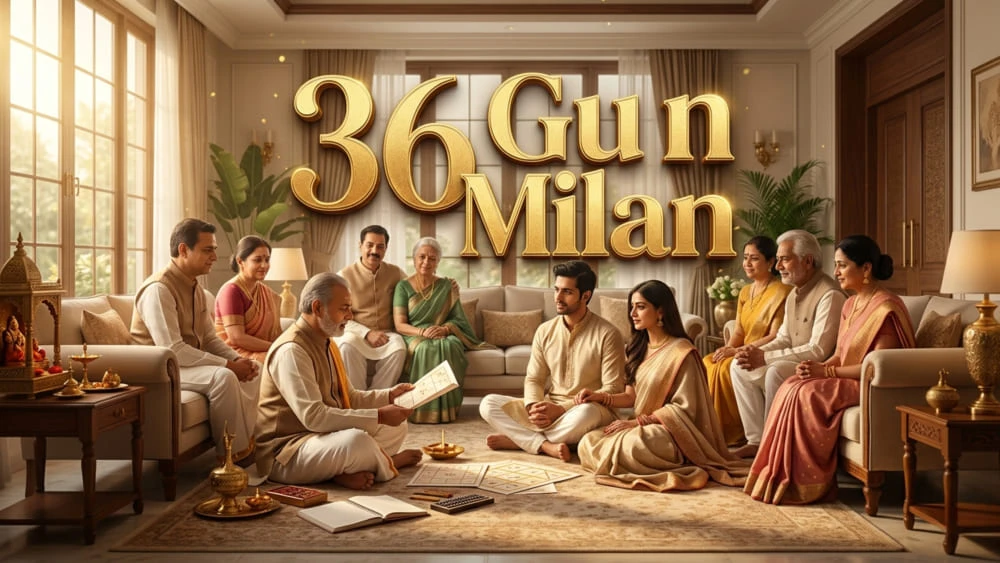
Enter both partners' date, time and place of birth for a 36-point Ashtakoot (Gun Milan) score. Every koota comes from each Moon's nakshatra and sign, so names alone are not enough. A score of 18 or more is traditionally treated as acceptable; Nadi, Bhakoot and Mangal dosha still need a separate look.
Calculator
Learn more
Understanding Ashtakoot Kundli Matching
What is Gun Milan (36 Guna)?
Gun Milan, also called Ashtakoot matching, compares eight factors (kootas) derived mainly from the Moon in each birth chart. Each koota awards a fixed maximum number of points; together they add up to 36. Higher totals generally indicate stronger emotional and lifestyle compatibility in classical marriage matching.
This calculator uses your Moon nakshatra, Moon sign, varna group, vashya type, yoni animal, gana temperament, nadi type, and the mutual Moon sign relationship (bhakoot) to mirror the traditional Ashtakoot framework.
Every koota is based on the Moon, so it helps to know each partner's Moon sign (rashi) and nakshatra. For a detailed PDF that explores cancellations, see the compatibility report.
Varna (1 point)
Varna reflects spiritual temperament and social role archetype (Brahmin, Kshatriya, Vaishya, Shudra) linked to birth Moon placement. In matching, the boy’s varna should ideally be equal or higher than the girl’s for full points, reflecting classical ideals of protection and respect within the union.
It is only one point; modern interpreters often treat it as a soft compatibility cue rather than a rigid hierarchy.
Vashya (2 points)
Vashya describes who may naturally “dominate” or influence the other emotionally, categories such as Manav (human), Vanchar (wild), Chatushpad (quadruped), Jalchar (water), and Keet (insect). A matrix compares the boy’s and girl’s categories to award 0–2 points.
Strong vashya harmony suggests easier mutual influence; clashes can show where negotiation and boundaries matter more.
Tara (3 points)
Tara counts nakshatra distance between the two Moons in both directions. Certain distances (related to divisions of nine) are considered inauspicious and score zero for that direction; auspicious distances contribute up to 1.5 points each way, for a maximum of 3.
Tara is about longevity, health, and overall fortune of the relationship timeline in classical texts.
Yoni (4 points)
Yoni assigns an animal symbol to each nakshatra (e.g., horse, elephant, sheep). Friendlier yoni pairs score higher; hostile pairs score lower. A full classical matrix can be very detailed; simplified calculators may use same-yoni vs different-yoni rules.
Yoni is read as instinctive compatibility, temperament, intimacy pacing, and primal comfort between partners.
Graha Maitri (5 points)
Graha Maitri compares the lords of the signs occupied by the two Moons. If those planets are natural friends in Vedic relationship tables, you get the highest score; neutrals score mid; enemies score zero.
This koota highlights whether the core emotional planets “speak the same language” by dispositor friendship.
Gana (6 points)
Gana classifies nakshatras as Deva (refined/sattvic), Manushya (human/mixed), or Rakshasa (intense/passionate). Classical matrices award 6 points for same-gana, moderate points for Deva–Manushya mixes, and low or zero for Rakshasa clashes with other ganas.
Gana differences are not “bad people”, they flag different emotional speeds and needs, where patience and maturity help.
Bhakoot (7 points)
Bhakoot examines the Moon sign positions relative to each other. Certain sign distances (for example 2–12, 5–9, 6–8 combinations in classical rules) form bhakoot dosha and score zero; favorable positions give all 7 points.
Bhakoot is associated with prosperity, children, and mutual well-being after marriage when Moons harmonize.
Nadi (8 points)
Nadi splits nakshatras into three groups, Adi, Madhya, and Antya, linked to prakriti / subtle body type. Same nadi for both partners scores zero (nadi dosha) because classical texts associate it with health or progeny friction; different nadis score full 8 points.
Many traditions allow exceptions (same nakshatra, different rashis, etc.); a full compatibility report explores cancellations.
Frequently asked questions
How many gunas should match for marriage?
Out of 36, a score of 18 or more is traditionally treated as acceptable, and higher scores suggest stronger compatibility. The total is only a starting point: Nadi and Bhakoot dosha and each partner's full chart also matter.
Can I match kundli by name only?
No. This calculator needs both partners' date, time and place of birth, because every koota comes from the exact position of the Moon: its nakshatra and sign.
What is Nadi dosha?
Nadi splits nakshatras into three groups: Adi, Madhya and Antya. If both partners share the same nadi the koota scores zero, which is called Nadi dosha; many traditions allow exceptions such as the same nakshatra with different rashis.
What is Bhakoot dosha?
Bhakoot compares the two Moon signs. Certain distances, such as 2–12, 5–9 and 6–8, form Bhakoot dosha and score zero out of 7; favourable positions score the full 7.
Is Mangal dosha part of Gun Milan?
No. The 36-point score does not include Mangal dosha, which is checked separately for each partner. Use the Mangal dosha calculator alongside this match.
You May Also Like
Calculators
Explore