
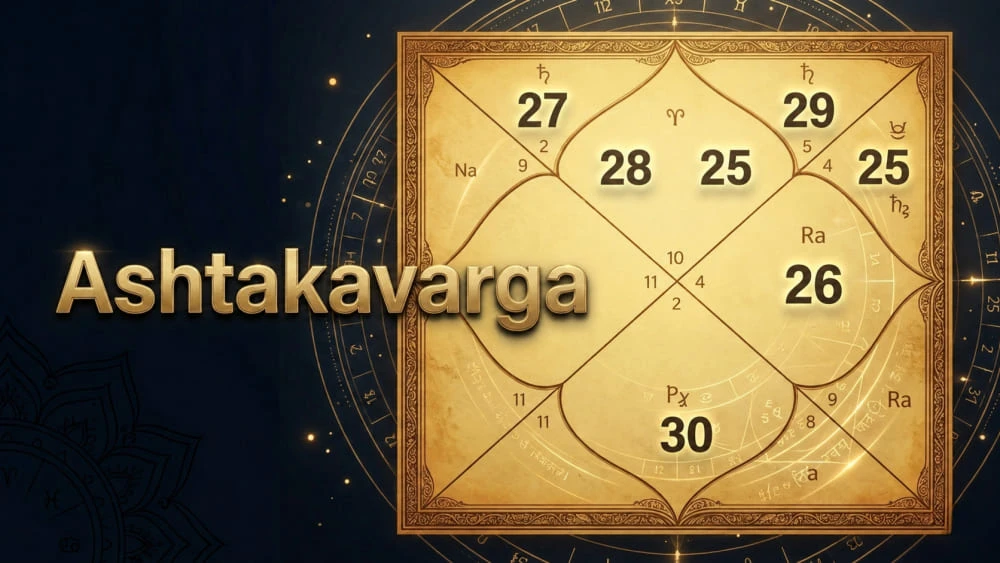
Ashtakvarga Calculator: Sarvashtakavarga & House Strength
Enter your date, time and place of birth to score every house. Eight contributors give points to each sign; Sarvashtakavarga adds them up from 0 to 56. A house with 28 or more is classically strong. Birth time matters because the score is tied to your ascendant.
Calculator
Select a Kundli
Choose whose chart to read
Learn more
What is Ashtakvarga?
Ashtakvarga (Sanskrit: अष्टकवर्ग, "eight-fold division") is a unique numerical system within Vedic astrology that measures the cumulative benefic strength of every sign and house in a birth chart. Unlike most chart analyses that consider one planet at a time, Ashtakvarga simultaneously weights contributions from eight sources: the Sun, Moon, Mars, Mercury, Jupiter, Venus, Saturn, and the Ascendant. The result is a precise point score for each of the 12 houses, turning abstract planetary strength into a concrete number you can compare, rank, and use for forecasting.
Sarvashtakvarga, The Grand Total
When you add the benefic scores of all eight contributors for every house, you get the Sarvashtakvarga, a single number per house ranging from 0 to 56. The sum of all 12 house totals gives the chart's grand total, which typically falls between 270 and 420. Astrologers use this grand total as a holistic indicator of overall chart strength.
| Grand Total Range | Grade | What It Means |
|---|---|---|
| ≥ 360 | Exceptionally Strong | Chart is overall highly auspicious; most life areas flourish with minimal effort. |
| 315 – 359 | Strong | Good fortune across most departments; challenges are manageable and temporary. |
| 270 – 314 | Average | Mixed results across life areas; sustained effort brings success. |
| < 270 | Needs Attention | Several life areas require conscious remediation and spiritual practice. |
Bhinnashtakvarga, The Planet Breakdown
Bhinnashtakvarga (individual Ashtakvarga) shows how many benefic points each of the eight contributors adds to every sign. A planet in a sign that has 5 or more of its own points tends to function strongly in that house; fewer than 3 points indicate a sign where that planet's themes are likely to face friction.
This breakdown is especially valuable for transit (Gochara) analysis. When a slow-moving planet like Saturn or Jupiter transits a sign, the Bhinnashtakvarga score of that sign in Saturn's or Jupiter's individual chart tells you whether the transit is likely to deliver favorable or challenging results, regardless of the natal planet's position.
To see which signs Saturn and Jupiter are moving through now, open the transit chart.
House Themes and Strength Thresholds
A house total of 28 or more in Sarvashtakvarga is the classical benchmark for a "strong" house. Houses scoring 25–27 are average, while those below 25 are considered weak and may require conscious attention, spiritual practices, or remedies to overcome recurring challenges in that life area.
| House | Life Area | Strength Note |
|---|---|---|
| House 1 | Self, personality, longevity | ≥28 supports vitality & charisma |
| House 2 | Wealth, family, speech | ≥28 supports financial stability |
| House 3 | Siblings, courage, short journeys | ≥28 brings communication success |
| House 4 | Mother, home, comforts, education | ≥28 gives domestic happiness |
| House 5 | Children, creativity, intellect | ≥28 amplifies creative output |
| House 6 | Enemies, health, service, debts | ≥28 supports overcoming obstacles |
| House 7 | Partnership, marriage, business | ≥28 favors lasting relationships |
| House 8 | Longevity, transformation, occult | ≥28 aids research & hidden knowledge |
| House 9 | Dharma, higher learning, fortune | ≥28 amplifies luck & wisdom |
| House 10 | Career, status, public reputation | ≥28 brings career recognition |
| House 11 | Gains, aspirations, social networks | ≥28 ensures income & goal fulfilment |
| House 12 | Liberation, foreign lands, losses | ≥28 favors spiritual growth |
Understanding AshtakVarga, Sarvashtakvarga & Bhinnashtakvarga
These three terms describe the same underlying system at different levels of granularity:
- Ashtakvarga, the overarching system of eight-source benefic point assignment.
- Bhinnashtakvarga , the individual point tables for each of the eight contributors (planet or Ascendant).
- Sarvashtakvarga , the combined (sum) point total per house after merging all eight Bhinnashtakvarga tables.
Why is exact birth time required?
Ashtakvarga is anchored to the Ascendant degree. Even a 30-minute error in birth time can shift the Ascendant into the next sign, causing all 12 house assignments to rotate by one step and completely changing your Sarvashtakvarga house totals. Accuracy to the nearest minute is recommended for reliable results.
Sidereal (Vedic) vs. Tropical
This calculator uses the Lahiri ayanamsha and the sidereal zodiac, which is the standard for Vedic astrology. Sidereal positions place the planets roughly 23–24° earlier than their tropical equivalents, so the sign assignments in your Ashtakvarga will differ from any Western astrology chart for the same birth data.
Frequently asked questions
What is a good Sarvashtakavarga total?
The chart's grand total usually falls between 270 and 420. Above 360 is exceptionally strong, 315–359 strong, 270–314 average, and below 270 needs attention.
What is a good Ashtakvarga score for a single house?
28 or more points makes a house auspicious or strong; 25–27 is mixed, and below 25 is where astrologers look for challenges. The active dasha and the full chart still provide context.
Can Ashtakvarga be used for timing?
Yes. When a slow planet like Saturn or Jupiter transits a sign, its Bhinnashtakavarga points there suggest how favourable the transit is; the kaksha system refines this to 3°45' segments.
Is Ashtakvarga the same as Shadbala?
No. Shadbala measures each planet's strength; Ashtakvarga measures how well each house is supported by all planets together. Serious readers use both.
Why does exact birth time matter?
Ashtakvarga is anchored to the ascendant. A 30-minute error can move the ascendant into the next sign and rotate all twelve house totals.
You May Also Like
Calculators
Explore