Ekadashi Explained: Why There Are 24 Ekadashis and How the Fast Works
Twice a month, on the eleventh day of the Moon, millions of Hindus fast for Vishnu. Here is what Ekadashi is, why there are 24 of them, and how the fast and parana actually work.
TrustAstrology Team · Last updated 29 November 2026 · 6 min read
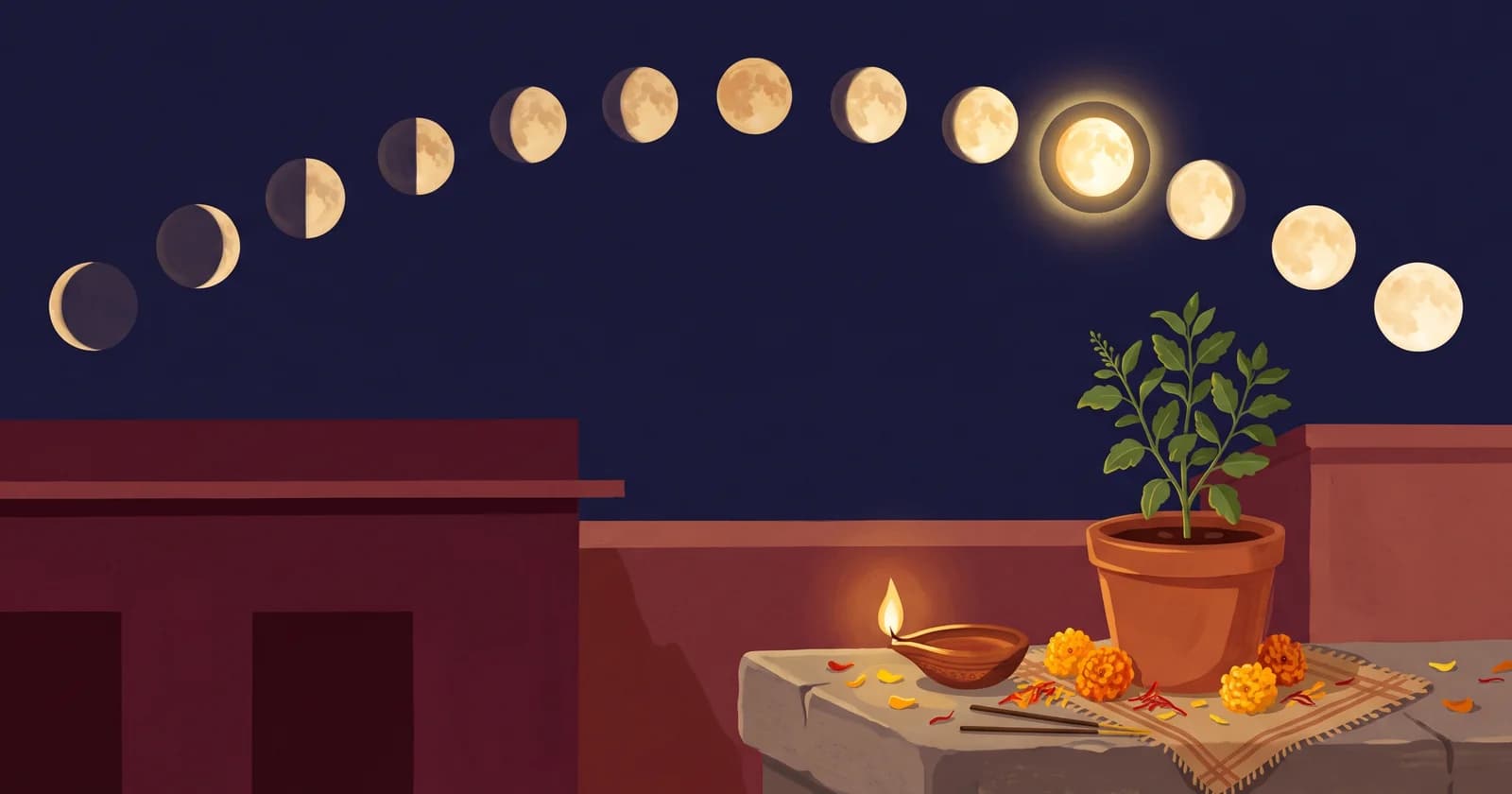
Ekadashi is the eleventh tithi of each lunar fortnight, once as the Moon waxes and once as it wanes. It is the most widely kept fast in Hinduism and is dedicated to Vishnu.
A normal year has 24 Ekadashis, two in each of the twelve lunar months. In a year with an extra lunar month (Adhik Maas), there are 26. Each Ekadashi has its own name and story: Nirjala, Devshayani, Dev Uthani, Mokshada, Vaikuntha and so on.
The fast runs from sunrise on Ekadashi to a set window after sunrise the next day, called parana. Grains and beans are avoided on the day, and the timing of the parana matters as much as the fast itself. The next two Ekadashis are Utpanna on 4 December and Mokshada on 20 December 2026.
What Ekadashi is
A tithi is the time it takes the Moon to gain 12 degrees on the Sun, and there are 15 in each fortnight. Ekadashi is the eleventh. It falls about four days before the full moon and about four days before the new moon.
The Puranas describe Ekadashi as a goddess born from Vishnu himself. In the story of Utpanna Ekadashi, Vishnu was resting in a cave after a long battle when the demon Mura attacked him. A radiant woman emerged from Vishnu's body and destroyed Mura. Pleased, Vishnu named her Ekadashi, since she had appeared on the eleventh day, and promised that anyone who honoured her by fasting on that day would be freed from their sins. That is why so many people begin keeping Ekadashi fasts on Utpanna Ekadashi.
Every Ekadashi of the year
The names below follow the amanta calendar, where each month runs from new moon to new moon: the first name is the waxing-moon Ekadashi of that month, the second the waning-moon one. North Indian (purnimanta) calendars attach the waning-moon Ekadashis to the following month, so you may see the same Ekadashi under a different month heading. We explain that in purnimanta vs amanta.
The 24 Ekadashis by lunar month (amanta)
| Waxing moon (Shukla) | Waning moon (Krishna) | |
|---|---|---|
| Chaitra | Kamada | Varuthini |
| Vaishakha | Mohini | Apara |
| Jyeshtha | Nirjala | Yogini |
| Ashadha | Devshayani | Kamika |
| Shravana | Shravana Putrada | Aja |
| Bhadrapada | Parsva (Parivartini) | Indira |
| Ashwin | Papankusha | Rama |
| Kartika | Prabodhini (Dev Uthani) | Utpanna |
| Margashirsha | Mokshada | Saphala |
| Pausha | Pausha Putrada | Shattila |
| Magha | Jaya | Vijaya |
| Phalguna | Amalaki | Papmochani |
In a year with Adhik Maas, the extra month adds two more: Padmini (or Kamala) and Parama Ekadashi. 2026 had an Adhik Jyeshtha in May and June, so this year has 26.
A few Ekadashis carry extra weight. Nirjala in early summer is kept without even water and is said to give the merit of all 24. Devshayani begins Chaturmas, when Vishnu rests, and Prabodhini ends it. We covered that one recently in Dev Uthani Ekadashi and Tulsi Vivah. Mokshada, in Margashirsha, is also Gita Jayanti and, in the South, Vaikuntha Ekadashi.
How the fast works
There is no single rulebook, and families follow different levels of strictness. The common forms are:
Nirjala. No food or water from sunrise to parana. The strictest form, kept by some on every Ekadashi and by many only on Nirjala Ekadashi.
Phalahar. Fruit, milk, nuts and the usual vrat foods such as sabudana, kuttu, singhara and rajgira flour, potatoes and rock salt. This is what most people keep.
One meal. A single simple meal without grains, often in the evening.
Across all forms, grains and beans are avoided: rice, wheat, dal and lentils. Many Vaishnava communities also avoid onion and garlic, and some avoid certain spices. Rice in particular is avoided on Ekadashi in almost every tradition.
The fast is meant to support prayer, not punish the body. Traditions have always made room for children, elders, pregnant women and anyone who is unwell to keep a lighter fast or simply pray. If you have a medical condition or take regular medicine, speak to your doctor before fasting.
Parana: breaking the fast correctly
Parana is the breaking of the fast on Dwadashi, the twelfth tithi. Tradition is particular about it:
Break the fast after sunrise on Dwadashi , within the window your panchang gives. Breaking it too late, after Dwadashi has ended, is traditionally treated like not completing the fast.
Avoid Hari Vasara , the first quarter of the Dwadashi tithi. If Hari Vasara is still running at sunrise, wait until it ends.
Avoid midday if you can. The morning window is preferred.
Start simply. Many people break the fast with a little water, tulsi or fruit, then eat a normal meal with rice or grains.
Because sunrise changes by city, the parana window does too. Check it in a panchang set to your location the evening before.
Why there are sometimes two Ekadashi dates
You will sometimes see Ekadashi listed on two consecutive days, often marked "Smarta" and "Vaishnava" (or "ISKCON").
Smarta calendars generally keep the fast on the day Ekadashi is present at sunrise. Vaishnava calendars are stricter: if the previous tithi, Dashami, is present in the hours just before an Ekadashi dawn, they treat that Ekadashi as mixed and fast the following day instead. Both are following their own tradition correctly. Pick the calendar your family or temple uses and stay with it.
Occasionally a tithi falls entirely between two sunrises. We saw this with Dev Uthani Ekadashi this year, and explained the general reason behind shifting festival dates in why Hindu festival dates change every year.
The next Ekadashis
Upcoming Ekadashis (India)
| Date | Note | |
|---|---|---|
| Utpanna | Fri, 4 Dec 2026 | Parana on the morning of 5 Dec |
| Mokshada | Sun, 20 Dec 2026 | Also Gita Jayanti and Vaikuntha Ekadashi; parana 21 Dec |
| Saphala | Early January 2027 | Check the panchang closer to the date |
On the day itself, Om Namo Narayanaya and the Vishnu Sahasranama are the most common chants.
Questions people ask
How many Ekadashis are there in a year?
There are 24 Ekadashis in a normal year, two in each lunar month. In a year with an extra lunar month, called Adhik Maas, there are 26. 2026 had an Adhik Maas in May and June, so it has 26 Ekadashis.
Why is rice not eaten on Ekadashi?
Tradition holds that grains, and rice in particular, should be avoided on Ekadashi, and many stories are told to explain it. In practice the rule is part of keeping the day simple and focused on prayer. Rice is eaten again after parana the next morning.
Can I drink water during the Ekadashi fast?
Yes, unless you are keeping a nirjala fast, which excludes water. Most people drink water and eat fruit and vrat foods. Nirjala is usually kept only on Nirjala Ekadashi in early summer, and is not advised for anyone with health concerns.
What happens if I miss the parana time?
Traditionally, breaking the fast after Dwadashi has ended is treated as an incomplete fast, which is why the parana window matters. If it happens, most families simply pray, accept it, and keep the next Ekadashi carefully. It is not a reason for worry.
What is the difference between Smarta and Vaishnava Ekadashi?
They follow different rules for days when Ekadashi and Dashami overlap near sunrise. Smarta calendars fast on the day Ekadashi prevails; Vaishnava calendars move the fast to the next day if Dashami touches the Ekadashi dawn. That is why the two can differ by one day.