
Dev Uthani Ekadashi and Tulsi Vivah 2026: Dates, Puja and Meaning
The four months of Chaturmas end this week. Here are the 2026 timings, why there are two Ekadashi dates, and how families wake Vishnu and marry Tulsi at home.
TrustAstrology Team · Last updated 16 November 2026 · 7 min read
Dev Uthani Ekadashi falls on Friday, 20 November 2026 for most households, and on Saturday, 21 November for Vaishnava communities such as ISKCON. Tulsi Vivah is performed on the evening of Saturday, 21 November, on Kartik Shukla Dwadashi.
The day closes Chaturmas, the four months that began on Devshayani Ekadashi on 25 July, when Vishnu is said to rest. With his waking, families start fixing weddings, house-warmings and mundan ceremonies again.
Below are the timings for 2026, the reason two calendars give two different dates, and a simple way to do both pujas at home.
Dev Uthani Ekadashi and Tulsi Vivah 2026 timings
The Ekadashi tithi begins on Friday morning and ends early on Saturday, which is why the fast is split between two days depending on which tradition you follow.
| Date | Time | |
|---|---|---|
| Ekadashi tithi begins | Fri, 20 Nov | 7:16 AM |
| Ekadashi tithi ends | Sat, 21 Nov | 6:32 AM |
| Fast (Smarta households) | Fri, 20 Nov | From sunrise |
| Parana (Smarta) | Sat, 21 Nov | 1:11 PM to 3:18 PM |
| Fast (Vaishnava households) | Sat, 21 Nov | From sunrise |
| Parana (Vaishnava) | Sun, 22 Nov | After sunrise |
| Dwadashi tithi | 21 Nov to 22 Nov | 6:32 AM to 4:57 AM |
| Tulsi Vivah | Sat, 21 Nov | Evening |
These are New Delhi timings. Sunrise changes from city to city, and so do tithi boundaries in local terms, so check the daily panchang for your location before you plan the parana.
Smarta parana on 21 November should start only after Hari Vasara, the first quarter of Dwadashi, ends at about 12:08 PM. Breaking the fast inside Hari Vasara is traditionally avoided.
Why there are two Ekadashi dates this year
The confusion comes from one rule: a day takes the tithi that is running at sunrise.
This year, Ekadashi touches neither sunrise. In Delhi, the Sun rises on Friday 20 November while Dashami is still running, because Ekadashi begins only at 7:16 AM. By Saturday's sunrise Ekadashi has already ended, at 6:32 AM, and Dwadashi has begun. A tithi that fits between two sunrises like this is called a kshaya tithi, and it forces every calendar to make a choice.
Smarta calendars place the fast on Friday, the day on which Ekadashi actually prevails, and keep Saturday for the parana while Dwadashi is still running.
Vaishnava calendars are stricter about Dashami. If Dashami is present in the hours before an Ekadashi dawn, they treat the fast as "mixed" and move it to the next day. So they fast on Saturday and break it on Sunday morning.
Neither side is making a mistake. They follow different rulebooks that were written down centuries apart. The practical advice is simple: follow whichever calendar your family or your temple has always used, and don't switch halfway through a year.
What "Dev Uthani" actually means
Dev Uthani means the waking of the deity. The day is also called Prabodhini Ekadashi (prabodhan is awakening), Devutthana Ekadashi, and in Maharashtra Kartiki Ekadashi.
The Puranic picture is of Vishnu resting on the serpent Shesha in the cosmic ocean through the rains. He lies down on Devshayani Ekadashi in Ashadha and rises on this Ekadashi in Kartik. While he rests, households hold back on the big beginnings: weddings, griha pravesh, the first haircut of a child, sacred thread ceremonies.
That is why this one Ekadashi carries more weight than most of the 24 in a year. It is the day the calendar opens up again.
In Pandharpur, Kartiki Ekadashi brings the second great pilgrimage of the year to the Vitthal temple, after the Ashadhi wari in the monsoon. Many families also begin Bhishma Panchak on this day, a five-day observance that runs to Kartik Purnima.
How the day is usually observed
Customs change from region to region, but most homes in North India follow some version of these steps.
The fast. Grains and rice are avoided, as on every Ekadashi. Some keep a nirjala fast without water; most eat fruit, milk and the usual vrat foods. Elders, pregnant women and anyone with a medical condition are traditionally allowed a lighter fast, and a doctor's advice comes first.
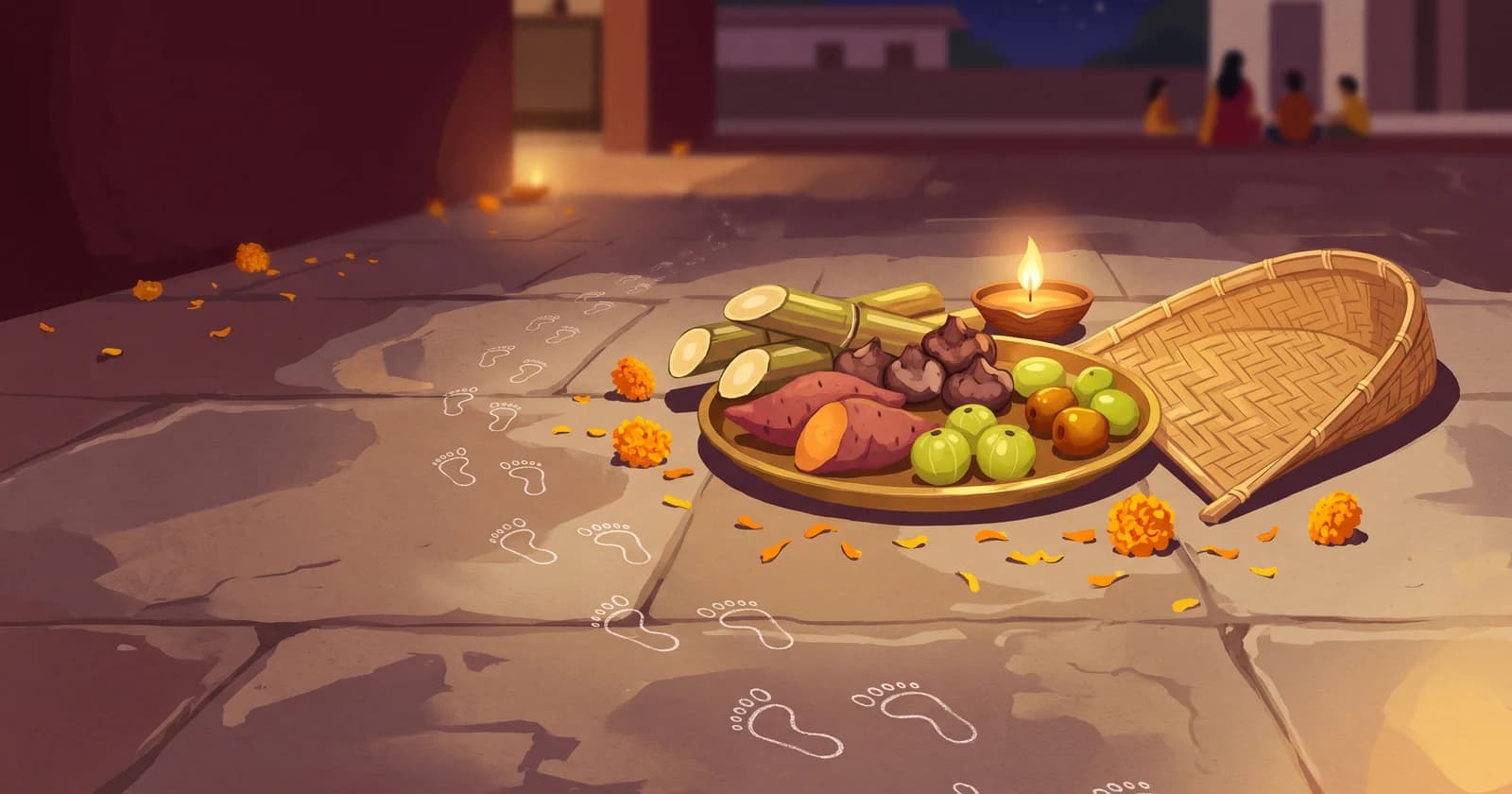
Drawing the footprints. In the evening, small footprints are drawn on the floor with chalk or geru to mark the deity's arrival. Many families cover them with a sieve or a parat.
Seasonal offerings. Sugarcane, water chestnut (singhara), sweet potato, ber, amla and other produce of the season are placed near the deity. This is the first time many homes taste the new sugarcane.
Waking Vishnu. Women gather, tap a thali or the parat, and sing a waking song. In many Hindi-speaking homes it begins "Utho Deva, baitho Deva". Then lamps are lit across the house.
Japa and jagran. Chanting Om Namo Narayanaya or the Vishnu Sahasranama is common, and some families keep a night vigil.
The story of Tulsi Vivah
Tulsi Vivah is the ceremonial wedding of the tulsi plant to Vishnu, usually in the form of a Shaligram stone or a small idol of Krishna.
The version most families know goes like this. Vrinda was the devoted wife of the asura king Jalandhar. Her chastity made her husband impossible to defeat, and the gods could not overcome him. Vishnu took Jalandhar's form and went to Vrinda, her vow was broken, and Jalandhar fell in battle. When Vrinda realised what had happened, she cursed Vishnu to become a stone, which is the Shaligram. She then gave up her body, and the tulsi plant grew where she had been. Vishnu, honouring her devotion, promised that he would always be married to her in the form of the tulsi, and that no offering to him would be complete without a tulsi leaf.
The story appears in different forms in different Puranas, and some details change between tellings. What stays the same is the point of the ritual: the household treats its tulsi as a daughter and gives her away in marriage.
How to do Tulsi Vivah at home
You don't need a priest to do a simple Tulsi Vivah, though many families invite one. A basic version looks like this.
Prepare the plant. Clean the tulsi pot and the space around it. Make a small mandap over it with four sugarcane stalks tied at the top.
Dress the bride. Drape the tulsi in a red or yellow cloth or chunri and add bangles, bindi and a little sindoor, as you would for a bride.
Place the groom. Set the Shaligram, or an idol of Vishnu or Krishna, beside the pot on a low stool. Dress it in a small yellow cloth.
Do the puja. Offer haldi, kumkum, flowers, sweets and the seasonal produce. Light a ghee lamp.
Kanyadaan and pheras. One member of the family performs the kanyadaan. The Shaligram is then carried around the tulsi seven times while the family sings.
Share the prasad. Distribute the sweets and fruit, and keep the lamp burning for the evening.
Some families perform the wedding on the evening of Ekadashi itself, and some hold it anywhere up to Kartik Purnima on 24 November. If your family has a fixed day, keep it.
Why it opens the wedding season
Once Vishnu is awake and Tulsi is married, the calendar is open for weddings again. Many families in North India treat Dev Uthani Ekadashi as an abujh day, one that needs no separate muhurat, though most pandits still prefer to fix a proper date for the wedding itself.
The first weeks after Tulsi Vivah are crowded. By mid-December the Sun enters Sagittarius, Kharmas begins, and weddings pause again until Makar Sankranti. If a wedding is being fixed in your family this season, the first step is still the match itself: kundli matching shows the guna score and flags Mangal dosha, and the compatibility report goes further into how the two charts work together.
Questions people ask
Is Dev Uthani Ekadashi on 20 or 21 November 2026?
Both, depending on your tradition. Smarta households fast on Friday 20 November and break the fast on the afternoon of 21 November. Vaishnava households, including ISKCON, fast on Saturday 21 November and break the fast on the morning of 22 November.
Can I eat rice on Dev Uthani Ekadashi?
Rice and grains are traditionally avoided on every Ekadashi, including this one. Most people eat fruit, milk, dry fruits, sabudana, singhara or kuttu flour and similar vrat foods. Rice is eaten again after parana the next day.
Do I need a Shaligram for Tulsi Vivah?
No. A Shaligram is traditional, but many families use a small idol or picture of Vishnu or Krishna instead. The care you bring to the ceremony matters more than the specific form you use for the groom.
When can Tulsi Vivah be performed?
Most families perform it on Kartik Shukla Dwadashi, which is the evening of 21 November in 2026. Others do it on Ekadashi itself, and some hold it on any evening up to Kartik Purnima on 24 November.
Can a wedding be held on Dev Uthani Ekadashi itself?
Many families in North India treat the day as abujh, auspicious enough not to need a muhurat, and weddings do take place on it. Others prefer to wait for a date chosen from both charts. If you are unsure, ask the pandit who will perform the wedding.