Purnimanta vs Amanta Calendar: Why Your Hindu Month Starts Later
Two Hindu calendars name the same fortnight differently. Once you see how each one counts a month, the "which month is it" confusion between North and South disappears.
TrustAstrology Team · Last updated 26 November 2026 · 5 min read
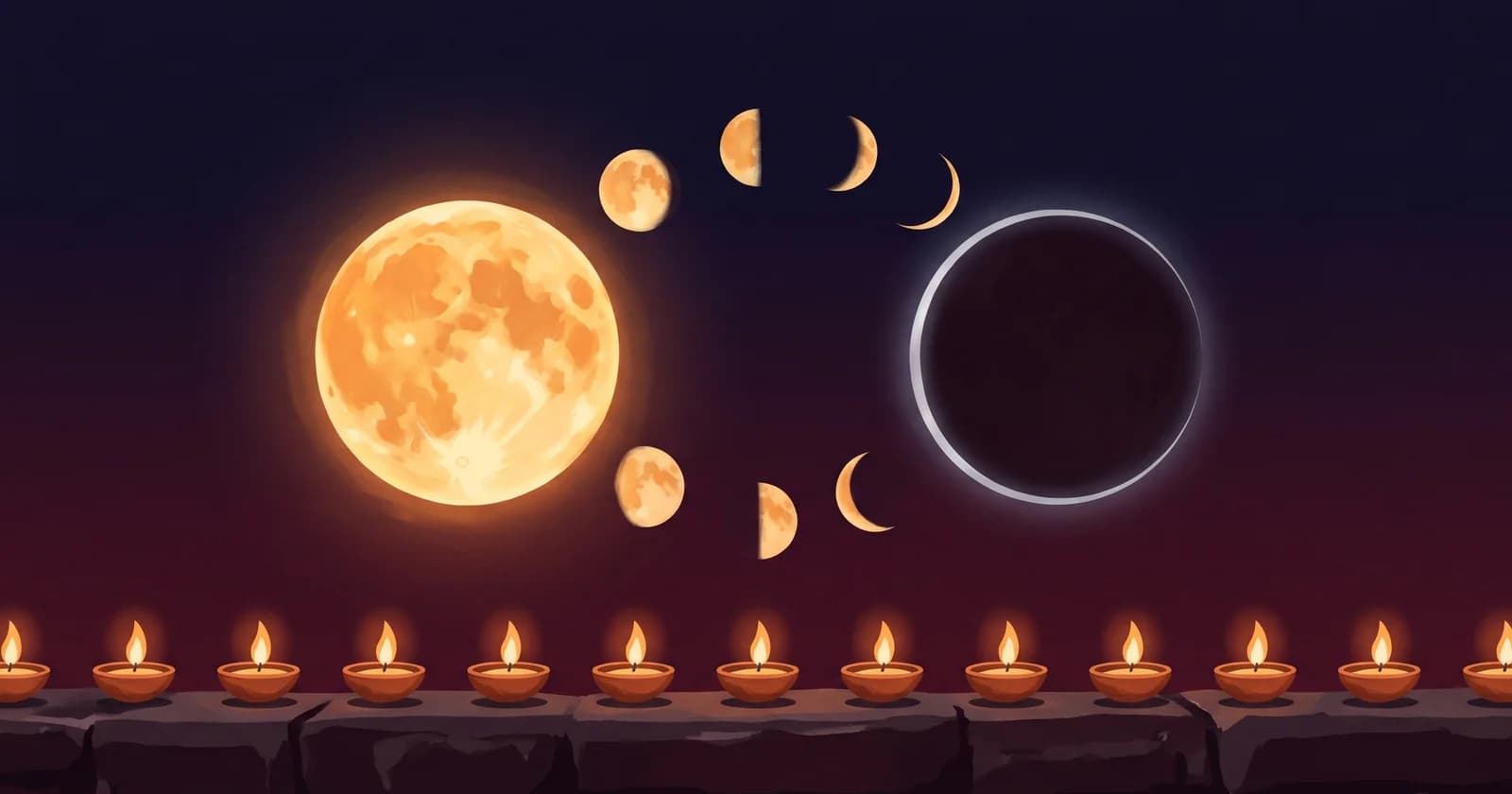
A purnimanta month runs from one full moon to the next. An amanta month runs from one new moon to the next. North India mostly uses purnimanta; Maharashtra, Gujarat, Karnataka, Andhra Pradesh and Telangana use amanta.
The two systems agree on every waxing fortnight (Shukla paksha) and on every festival date. They disagree only about which month the waning fortnight (Krishna paksha) belongs to. In the purnimanta system it opens the month; in the amanta system it closes the month.
You can see it right now. This year Margashirsha began on 25 November in Delhi, the day after Kartik Purnima, but begins on 9 December in Pune, the day after the new moon. Kalabhairav Jayanti on 1 December is "Margashirsha Krishna Ashtami" in one calendar and "Kartika Krishna Ashtami" in the other, and both cities celebrate it on the same day.
What each calendar actually is
Both are lunisolar calendars. Months follow the Moon, and an extra month is added every two or three years to keep them in step with the seasons. Both divide each month into two fortnights of fifteen tithis each. They differ in one choice: where the month begins.
Purnimanta (literally "ending at the full moon") starts each month on the day after Purnima. The waning fortnight comes first, then the waxing fortnight, and the month ends at the next full moon. This is the common system in Uttar Pradesh, Bihar, Madhya Pradesh, Rajasthan, Punjab, Haryana, Delhi, Uttarakhand, Himachal Pradesh, Jharkhand and Chhattisgarh.
Amanta (literally "ending at the new moon") starts each month on the day after Amavasya. The waxing fortnight comes first, then the waning fortnight, and the month ends at the next new moon. This is the common system in Maharashtra, Gujarat, Goa, Karnataka, Andhra Pradesh and Telangana. It is also the convention most astronomical texts use.
Tamil Nadu, Kerala, West Bengal, Odisha and Assam also follow solar months for civil purposes, named after the Sun's sign rather than the Moon. That is a third system and a separate story, but it is why Margazhi in Tamil Nadu always begins around 16 December.
Which months line up, and which don't
Here is the key idea: the waxing fortnights are named identically in both systems. Only the waning fortnights get a different month name.
The same days in both calendars, November and December 2026
| Purnimanta (North India) | Amanta (Maharashtra, Gujarat, South) | |
|---|---|---|
| 10 to 24 Nov (waxing) | Kartika Shukla | Kartika Shukla |
| 25 Nov to 8 Dec (waning) | Margashirsha Krishna | Kartika Krishna |
| 9 to 23 Dec (waxing) | Margashirsha Shukla | Margashirsha Shukla |
| 24 Dec to early Jan (waning) | Pausha Krishna | Margashirsha Krishna |
So for any waning-moon festival, the purnimanta calendar is always one month "ahead" in name. Janmashtami, for example, is Bhadrapada Krishna Ashtami in North India and Shravana Krishna Ashtami in Maharashtra. Maha Shivaratri is Phalguna Krishna Chaturdashi in one and Magha Krishna Chaturdashi in the other. Same night, two names.
Waxing-moon festivals carry the same month name everywhere. Rama Navami is Chaitra Shukla Navami across India, and Ganesh Chaturthi is Bhadrapada Shukla Chaturthi across India.
Why the festival dates still match
A festival is fixed to a tithi, not to a month name. Janmashtami is the eighth tithi of the waning moon that falls in late August or early September. Both calendars point at the same tithi. They just give it different month labels.
So if a friend in Pune and a friend in Lucknow tell you different months for Kalabhairav Jayanti, both are right, and they'll still light their lamps on the same evening. When festival dates do differ by a day between two calendars, the cause is almost always something else: the sunrise rule or the time of day a ritual needs. We explain those causes in why Hindu festival dates change every year.
Where the difference actually matters
Most of the time the two systems are a naming question. They become a practical question in four situations.
Reading an old horoscope or family record. A birth noted as "Margashirsha Krishna Ashtami" in a Kashi panchang and one noted as "Kartika Krishna Ashtami" in a Pune panchang can be the same day. Before converting a traditional date to the Gregorian calendar, find out which system the record used.
Month-long vows. Observances tied to a month, such as the Margashirsha Guruvar Lakshmi vrat in Maharashtra, follow the local amanta month: in 2026 they run on Thursdays from 10 December, not from late November.
Ekadashi names. The twenty-four Ekadashis have names attached to months. The waning-moon Ekadashi of early December is Utpanna Ekadashi in both calendars, but its month heading differs, which confuses people looking it up in two lists.
The extra month. When an Adhik Maas is inserted, the two systems attach it at slightly different points, which can shift month names for a few weeks.
If you only want to know what day a festival falls on, use a panchang set to your city and ignore the month names.
Neither calendar will settle these questions:
Why my festival is a day earlier abroad. That comes from local sunrise, not from the month system.
Why Tamil months start mid-month. Tamil Nadu uses solar months tied to the Sun's sign, a third system.
Which date to keep for a family ritual. That is a question for your family's priest or tradition, not for the calendar.
Questions people ask
Which calendar does North India follow, purnimanta or amanta?
Most of North India follows the purnimanta calendar, in which months end at the full moon. That includes Uttar Pradesh, Bihar, Madhya Pradesh, Rajasthan, Delhi, Punjab and Haryana. Maharashtra, Gujarat and the Telugu and Kannada regions follow amanta, ending months at the new moon.
Do festivals fall on different days in the two calendars?
No. Festivals are tied to tithis, and both calendars count tithis the same way. Only the month name given to the waning fortnight differs. When two calendars show different days, the cause is usually local sunrise or a timing rule, not the month system.
Why is the waning fortnight in a different month?
Because the two calendars start the month at different points. Purnimanta begins the month just after the full moon, so the waning fortnight comes first. Amanta begins just after the new moon, so the waning fortnight comes last and belongs to the earlier month.
Which calendar is used in astrology?
Birth charts are calculated from planetary positions, not month names, so both give the same chart. Many astrological and astronomical texts use the amanta convention for naming months. For tithi, nakshatra and dates, any good panchang works whichever month system it prints.
When does Margashirsha start in 2026?
In the purnimanta calendar Margashirsha began on 25 November 2026 and ends at the full moon of 23 and 24 December. In the amanta calendar it begins on 9 December 2026 and ends at the new moon in early January 2027.