Why Hindu Festival Dates Change Every Year: Tithi vs Calendar Date
Hindu festivals are fixed to the Moon, not to the Gregorian calendar. Once you see how a tithi works, the shifting dates and the yearly arguments start to make sense.
TrustAstrology Team · Last updated 18 November 2026 · 7 min read
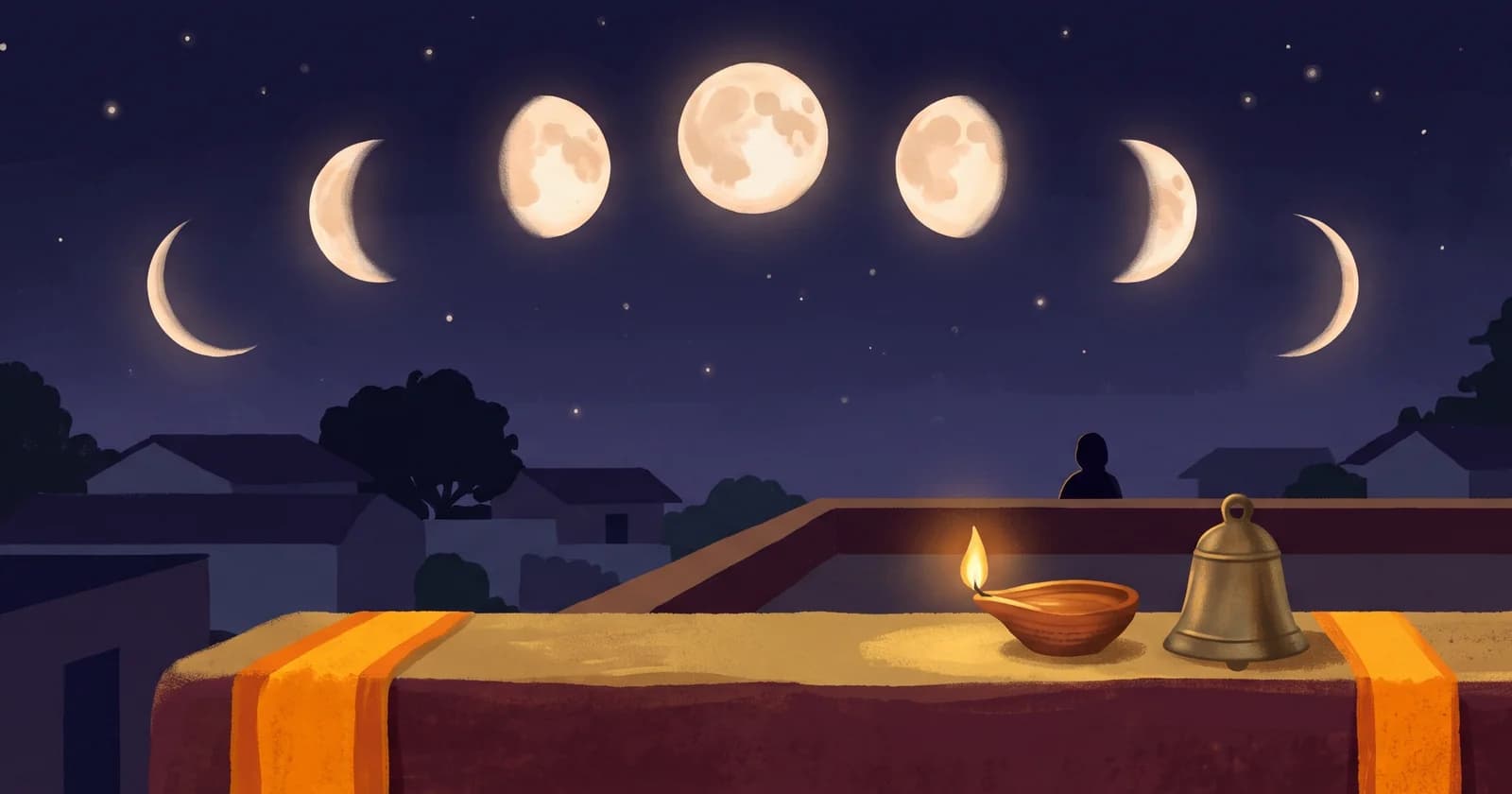
Hindu festivals are tied to a tithi, a lunar day, and not to a date on the Gregorian calendar. A lunar year is about eleven days shorter than a solar year, so each festival slides earlier year after year, until an extra month is added and it jumps forward again.
That is why Diwali fell on 20 October in 2025 and on 8 November in 2026. The extra month this year was Adhik Jyeshtha, from 17 May to 15 June 2026, and every lunar festival after it moved about three weeks later than last year.
The other source of confusion is smaller but louder: when a tithi starts in the middle of a day, different calendars apply different rules to decide which day gets the festival. This article explains both, with real examples from this year.
A festival belongs to a tithi, not a date
A tithi is the time it takes the Moon to gain 12 degrees on the Sun. There are 30 of them in a lunar month: 15 in the waxing half (Shukla paksha) ending at Purnima, and 15 in the waning half (Krishna paksha) ending at Amavasya.
Because the Moon's speed changes through its orbit, a tithi is not a fixed length. It can last as little as about 19 hours or as long as about 26. A tithi rarely begins at midnight or at sunrise. It begins whenever the Moon reaches the next 12-degree mark, which might be 3:40 in the afternoon.
Every major festival is defined by a tithi in a particular lunar month:
Diwali. Amavasya of Kartik (Ashwin in some calendars).
Janmashtami. Ashtami of the waning half of Bhadrapada.
Ram Navami. Navami of the waxing half of Chaitra.
Ganesh Chaturthi. Chaturthi of the waxing half of Bhadrapada.
Every Ekadashi. The eleventh tithi of each half of each month.
You can see today's tithi, nakshatra and the rest of the day's details on our panchang.
Why a tithi that starts mid-afternoon causes arguments
Days run from sunrise to sunrise in the Hindu calendar. The basic rule, called udaya tithi, is that a day takes the tithi running at sunrise. Most of the time that settles it.
But many festivals are tied to a particular part of the day, called the karmakala, when the ritual has to be done:
When in the day each festival's tithi must be present
| Required time | Why | |
|---|---|---|
| Diwali (Lakshmi Puja) | Pradosh, the period after sunset | The puja is an evening puja |
| Janmashtami | Nishita, around midnight | Krishna's birth is placed at midnight |
| Ram Navami | Madhyahna, around midday | Rama's birth is placed at noon |
| Ganesh Chaturthi | Madhyahna | The puja is done at midday |
| Ekadashi fast | Sunrise, with rules about Dashami | The fast is a whole-day vow |
Now picture a tithi that begins in the afternoon of day one and ends in the evening of day two. Is it present at sunset on day one? Yes. On day two? Only if it lasts beyond sunset. Different panchang committees weigh these conditions differently, and they can reach different answers.
Diwali 2024 as an example
In 2024, Amavasya began on the afternoon of 31 October and ended on the evening of 1 November. On 31 October, Amavasya covered both pradosh and the night. On 1 November it covered the sunrise but slipped out shortly after sunset. Most panchangs and many scholarly bodies, including several in Kashi, chose 31 October. Some regional committees chose 1 November. News sites ran "31 October or 1 November?" explainers for a week.
Ekadashi this month
The same thing happens this month. Dev Uthani Ekadashi begins after sunrise on 20 November 2026 and ends before sunrise on 21 November, touching neither sunrise. Smarta calendars put the fast on Friday, Vaishnava calendars on Saturday. We explain the two rules in our post on Dev Uthani Ekadashi and Tulsi Vivah.
Why your city changes the answer
Tithis begin at the same instant everywhere on Earth. Sunrise does not.
India runs on a single time zone but spans nearly 30 degrees of longitude. In November, the Sun rises in Guwahati more than an hour before it rises in Ahmedabad. If a tithi begins at 6:30 AM IST, it is already running at sunrise in Ahmedabad and not yet running at sunrise in Guwahati. The two cities can, quite correctly, observe a fast on different days.
Abroad the gap widens. This year Kartik Purnima and Karthigai Deepam fall on Tuesday 24 November in India, but on Monday 23 November across most of North America. Temples in the United States are not being careless. They are calculating for their own sunrise.
The extra month that resets the calendar
Twelve lunar months add up to about 354 days. The solar year is about 365. Left alone, lunar festivals would drift through every season. Diwali would eventually land in the monsoon.
The Hindu calendar fixes this with Adhik Maas, an extra lunar month. The rule is neat: a lunar month in which the Sun does not move into a new sign (no Sankranti happens) becomes an Adhik Maas, and the month after it takes the regular name. This happens roughly once every 32 or 33 months.
In 2026 the extra month was Adhik Jyeshtha, also called Purushottam Maas, from 17 May to 15 June. That is why the festivals of the second half of this year all felt late compared to 2025:
The same festivals in 2025 and 2026
| 2025 | 2026 | |
|---|---|---|
| Diwali | 20 October | 8 November |
| Dev Uthani Ekadashi | 1 November | 20 November |
| Kartik Purnima | 5 November | 24 November |
Next year, with no extra month, the festivals will slide earlier again by around eleven days.
Why solar festivals barely move
Some festivals follow the Sun instead of the Moon. They are fixed to a Sankranti, the moment the Sun enters a new sidereal sign, and these hardly move at all on the Gregorian calendar.
Makar Sankranti and Pongal. The Sun enters Capricorn, around 14 or 15 January.
Baisakhi, Vishu and Puthandu. The Sun enters Aries, around 13 or 14 April.
Dhanu Sankranti. The Sun enters Sagittarius, around 15 or 16 December, which begins Kharmas.
Even these drift, but slowly: about one day every 70 years or so, because the Gregorian year is tied to the seasons and the sidereal zodiac is tied to the stars. Swami Vivekananda was born on 12 January 1863, a day that was Makar Sankranti in that year. Today the festival falls two or three days later.
Which date should you follow?
There is no single "correct" all-India date for a tithi-based festival. There is a correct date for a given rulebook and a given place.
So the practical rule is to choose one source and stay with it. If your family follows a particular sampradaya or a local temple, follow its calendar. If you want a calculation for your own city, use a panchang that asks for your location rather than one printed for Delhi or Ujjain. Most of the yearly confusion comes from mixing a WhatsApp forward with a wall calendar from another state.
Questions people ask
Why does Google show a different festival date from my family calendar?
Search results and apps usually take dates from one published panchang, often calculated for New Delhi. Your family calendar may follow a different rulebook or another city's sunrise. Both can be right on their own terms, so follow the source your family and temple use.
Why are ISKCON Ekadashi dates sometimes a day later?
ISKCON follows Vaishnava rules, which do not accept an Ekadashi that is touched by Dashami in the hours before dawn. When that happens, the fast moves to the next day. Smarta calendars apply a looser rule, so the two can differ by a day.
Is Adhik Maas an inauspicious month?
It is treated as unsuitable for new beginnings such as weddings and house-warmings, because it has no Sankranti of its own. At the same time it is called Purushottam Maas and is considered a very good month for prayer, charity and religious study. So it is quiet rather than unlucky.
Why is Makar Sankranti sometimes on 15 January?
Makar Sankranti happens when the Sun enters sidereal Capricorn. If that moment falls after sunset, or late in the day, many calendars move the festival to the next day. The moment itself is slowly getting later over the centuries, so 15 January is becoming more common.
Why do Indians abroad sometimes celebrate a day earlier?
A tithi begins at the same instant worldwide, but sunrise in America comes many hours after sunrise in India. A tithi that is already running at Indian sunrise may not yet have begun at American sunrise on the same calendar date, so the festival shifts.