Vimshottari Dasha Explained: How Your Planetary Periods Work
The dasha system is how Vedic astrology answers "when". Here is how the 120-year cycle is built from your birth Moon, and how to read the period you are in right now.
TrustAstrology Team · Last updated 28 November 2026 · 6 min read
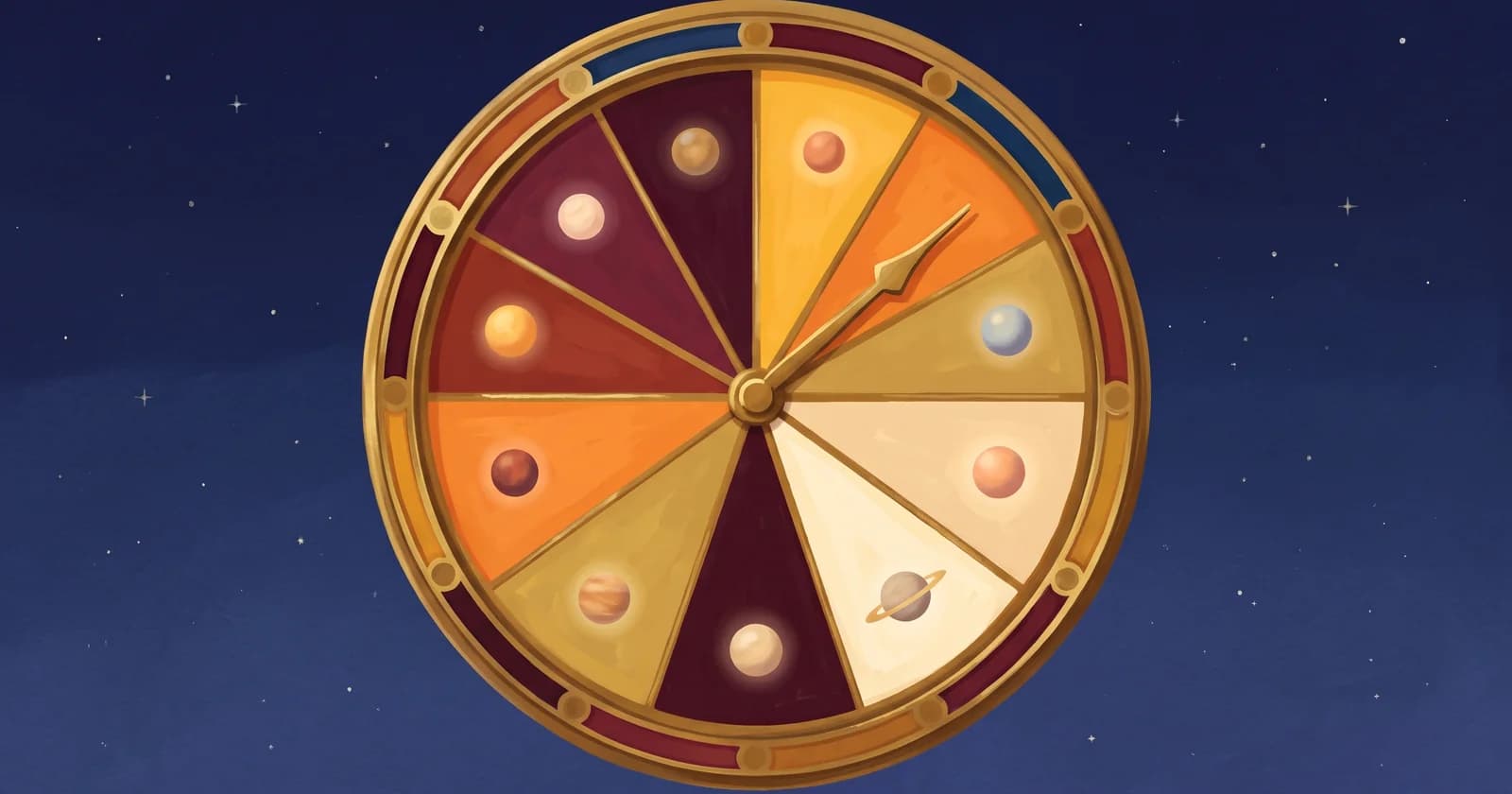
Vimshottari dasha is a 120-year cycle of planetary periods, called mahadashas, that Vedic astrology uses to time events in a life. Each of the nine planets rules one period, from 6 years for the Sun to 20 years for Venus, always in the same order.
Where you start in the cycle depends on one thing: the nakshatra the Moon was in when you were born. The planet that rules that nakshatra rules your first mahadasha, and the Moon's exact position inside the nakshatra decides how much of it was left at birth.
Each mahadasha is then divided into nine antardashas (sub-periods), and those into smaller periods again. Reading which planet runs the main period and which runs the sub-period is the most common way astrologers answer questions about timing.
The nine periods and their order
The sequence never changes. After Mercury, the cycle returns to Ketu.
The Vimshottari mahadashas in order
| Years | Nakshatras it rules | |
|---|---|---|
| Ketu | 7 | Ashwini, Magha, Mula |
| Venus | 20 | Bharani, Purva Phalguni, Purva Ashadha |
| Sun | 6 | Krittika, Uttara Phalguni, Uttara Ashadha |
| Moon | 10 | Rohini, Hasta, Shravana |
| Mars | 7 | Mrigashira, Chitra, Dhanishta |
| Rahu | 18 | Ardra, Swati, Shatabhisha |
| Jupiter | 16 | Punarvasu, Vishakha, Purva Bhadrapada |
| Saturn | 19 | Pushya, Anuradha, Uttara Bhadrapada |
| Mercury | 17 | Ashlesha, Jyeshtha, Revati |
The years add up to 120, the traditional span of a full human life. Most people live through five or six mahadashas, never the whole cycle.
Notice that the order of planets matches the order of the nakshatras. The 27 nakshatras are simply the same nine-planet sequence repeated three times around the zodiac. That is why the system is called Vimshottari, "of one hundred and twenty", and why the Moon's nakshatra fixes your starting point.
How your starting point is calculated
The Moon moves through one nakshatra, 13 degrees and 20 minutes of the zodiac, in about a day. The fraction of the nakshatra the Moon had still to travel at your birth is the fraction of the first mahadasha you had still to live.
A worked example
Say the Moon was at 15 degrees of Taurus at birth.
Find the nakshatra. Rohini runs from 10°00' to 23°20' Taurus, so the Moon is in Rohini, which is ruled by the Moon. The first mahadasha is the Moon's, which lasts 10 years in full.
Measure how far it has gone. The Moon is 5 degrees into a nakshatra that is 13°20' (13.33 degrees) wide. It has travelled 37.5 percent of the way, and has 62.5 percent left.
Work out the balance. At birth, 62.5 percent of the Moon's 10 years remained: 6 years and 3 months.
Continue the sequence. After that, the periods follow the fixed order: Mars for 7 years, Rahu for 18, Jupiter for 16, and so on.
This person would run the Moon dasha until about age 6, Mars until about 13, Rahu until about 31, and Jupiter until about 47.
Because the Moon moves quickly, the birth time matters. A two-hour error moves the Moon by about a degree, which shifts every dasha start date in your life by roughly nine months in this example. You can find your Moon's nakshatra with the nakshatra calculator, and your whole sequence with dates in the dasha calculator.
Mahadasha, antardasha and the smaller periods
Each mahadasha is divided into nine antardashas, in the same planetary order, starting with the mahadasha planet itself. Each antardasha's length is proportional to its planet's share of 120 years.
The formula is simple: mahadasha years × antardasha planet's years ÷ 120.
Saturn-Saturn. In a Saturn mahadasha (19 years), the Saturn antardasha comes first and lasts 19 × 19 ÷ 120 = about 3 years.
Saturn-Mercury. Next comes Mercury: 19 × 17 ÷ 120 = about 2 years 8 months.
Saturn-Ketu. Then Ketu: 19 × 7 ÷ 120 = about 1 year 1 month, and so on through the other six.
Astrologers write these as "Saturn-Mercury" or "Sa/Me", the main period first. Each antardasha can be split again into pratyantardashas lasting weeks or months, which are used for finer timing.
How astrologers read a dasha
A dasha period doesn't mean "Saturn happens to you for 19 years". It means the matters that Saturn controls in your chart come into focus. Reading a period well depends on a few questions:
Where is the planet in your chart? Which house it occupies and which houses it rules decide the areas of life it activates. The same Venus dasha can be about marriage in one chart and about property or the arts in another.
How strong is it? A planet in its own or exalted sign, well aspected, tends to give its results more easily than one that is debilitated or afflicted.
What is the sub-period planet? The antardasha planet colours the main period. Its relationship to the mahadasha planet, whether friendly or hostile, and their positions from each other, matter a great deal.
What are the transits doing? The dasha shows what is ripe to happen; transits of slow planets such as Saturn and Jupiter often show when. The current shift of Rahu into Capricorn and Ketu into Cancer will feel strongest to people already running a Rahu or Ketu period.
If you want a reading of the period you are in now, our page on whether your current dasha is good walks through it from your birth details.
Why two calculations sometimes disagree
If you compare your dasha dates across two apps and find differences of a few days or weeks, there are three usual causes.
Ayanamsa. Vedic astrology uses the sidereal zodiac, and different schools set its starting point slightly differently. Lahiri ayanamsa is the most common in India. A different ayanamsa moves the Moon slightly, and with it the dates.
Year length. Some software counts a dasha year as 365.25 days, others as 360 days (a traditional "savana" year). Over a 20-year period that adds up to months.
Birth time. As in the example above, small differences in birth time shift every period.
None of these change the order of your dashas, only the dates. Pick one well-documented setting and keep it.
What a dasha can't tell you
Dashas are a framework for timing, not a script. A good astrologer uses them to point at periods when certain themes are likely to be more active. They can't say what you will choose to do with those periods, and they don't override effort, circumstances or plain luck.
Be cautious with any reading that tells you a whole mahadasha will be uniformly "bad". Every period in every chart mixes easier and harder times, and the sub-periods are where that variation shows.
Questions people ask
What is the difference between mahadasha and antardasha?
The mahadasha is the main planetary period, lasting from 6 to 20 years. Each mahadasha is divided into nine antardashas, or sub-periods, ruled by each planet in turn. The antardasha planet colours the main period, so astrologers usually read the two together.
How do I find out which dasha I am running now?
You need your date, time and place of birth. From these, the Moon's nakshatra at birth is worked out, and the dasha sequence is counted forward from it. The dasha calculator on TrustAstrology gives your current mahadasha and antardasha with their dates.
Which mahadasha is the longest?
Venus has the longest mahadasha at 20 years, followed by Saturn at 19, Rahu at 18, Mercury at 17 and Jupiter at 16. The Sun's is the shortest at 6 years, and Ketu and Mars run for 7 years each.
Is Saturn mahadasha always difficult?
No. Saturn's period works through the houses Saturn rules and occupies in your chart, and for some ascendants Saturn is among the most helpful planets. It often brings responsibility and slow, steady work, and many people build their most lasting results in it.
Why does my dasha change if my birth time is slightly wrong?
The Moon moves about one degree every two hours, and the dasha balance at birth depends on the Moon's exact position inside its nakshatra. A wrong birth time changes that position, which moves the start date of every period that follows.