Rahu in Capricorn, Ketu in Cancer: What the 2026 to 2028 Shift Means
The two shadow planets change signs only once every year and a half. This December they move onto the Capricorn and Cancer axis, where they will stay until mid 2028.
TrustAstrology Team · Last updated 22 November 2026 · 7 min read
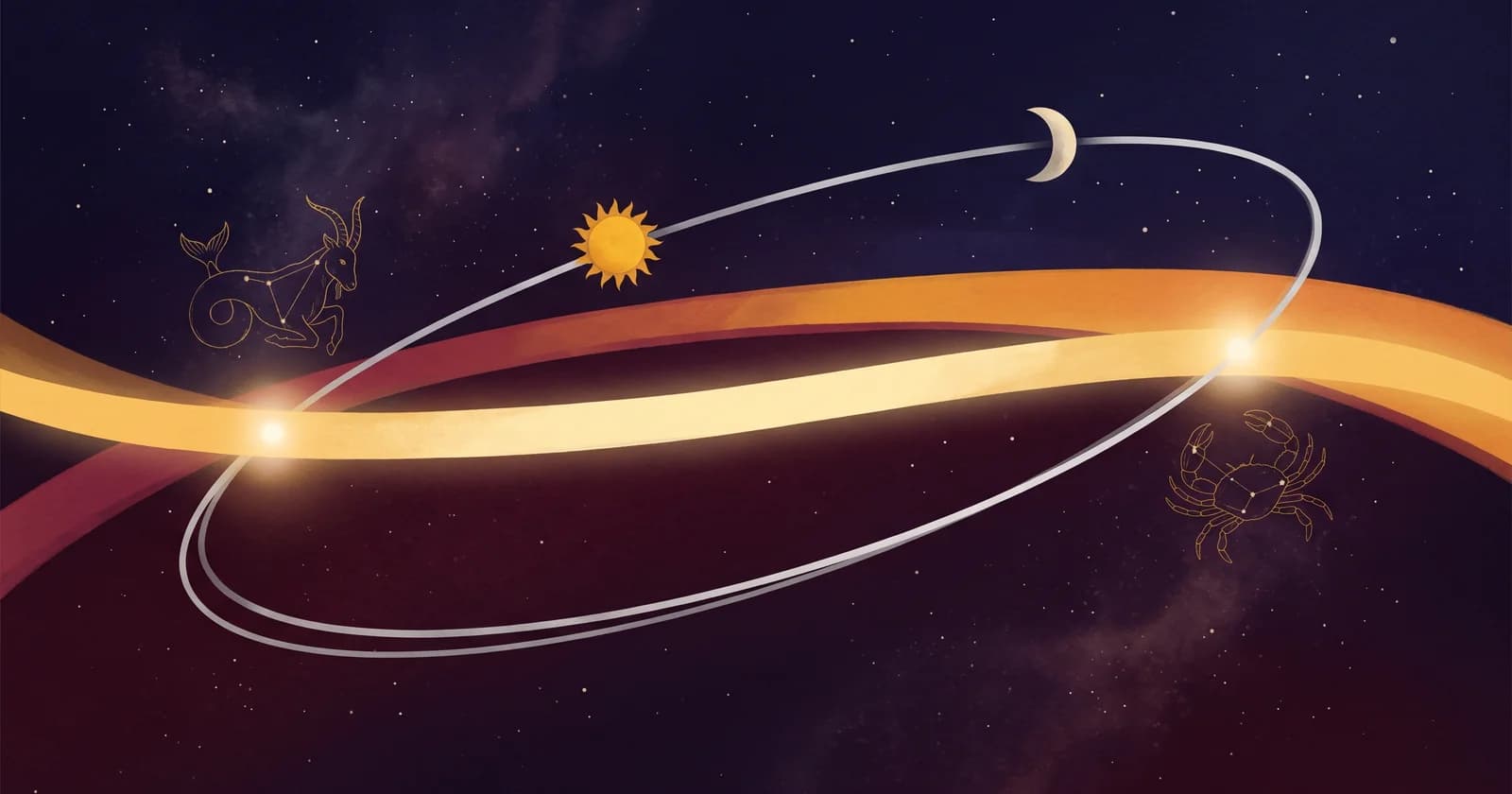
On Saturday, 5 December 2026, Rahu leaves Aquarius and enters Capricorn, and Ketu leaves Leo and enters Cancer. They will stay on this axis for about eighteen months, until around June 2028.
Rahu and Ketu are the slowest-changing influence in a Vedic chart after Saturn. Their move into a new pair of signs shifts the background of the year for everyone, and for some people it opens a long chapter.
Some calendars give 25 November as the date instead. That isn't an error: it comes from calculating the "true" position of the nodes rather than the "mean" one most Indian panchangs use. We explain the difference further down.
The dates of this transit
The Rahu and Ketu transit, 2025 to 2028
| Rahu | Ketu | |
|---|---|---|
| Previous sign | Aquarius, from 18 May 2025 | Leo, from 18 May 2025 |
| New sign | Capricorn | Cancer |
| Entry (mean node) | 5 December 2026 | 5 December 2026 |
| Entry (true node) | About 25 November 2026 | About 25 November 2026 |
| Sign ruler | Saturn | Moon |
| Expected to leave | Around June 2028 | Around June 2028 |
Rahu and Ketu always sit exactly opposite each other and always move backwards through the zodiac, so they leave a sign from its first degree. Rahu therefore enters Capricorn at its last degree and works back towards the start of the sign over the next year and a half.
What Rahu and Ketu are
Rahu and Ketu aren't physical bodies. They are the two points where the Moon's orbit crosses the Sun's apparent path through the sky. Rahu is the north node, where the Moon crosses going north; Ketu is the south node.
Eclipses happen only when the Sun and Moon line up near these points, which is how the nodes earned their place in Jyotish. The old story is that the asura Svarbhanu drank the nectar of immortality in disguise, was beheaded by Vishnu's discus, and became two beings: Rahu, the head, and Ketu, the body. Ever since, they chase the Sun and Moon and swallow them during eclipses.
In a chart, Rahu is read as appetite and ambition: the area of life you are drawn towards, sometimes too strongly. Ketu is read as release and detachment: the area where you already know a lot, and where the hunger has gone out of things. You can read more on each at our pages for Rahu and Ketu.
Why this particular axis matters
A sign pair is read through what each sign stands for, and through the planet that rules it.
Capricorn is ruled by Saturn. Traditionally it stands for work, structure, institutions, public standing and long effort. It is the natural tenth sign of the zodiac, the sign of career and karma in the world.
Cancer is ruled by the Moon. It stands for home, mother, emotional security, belonging, land and roots. It is the natural fourth sign, the sign of the private life.
So the new axis puts Rahu's ambition into the public, working side of life, and Ketu's detachment into the home and the inner life. Many astrologers expect this period to bring attention to careers, governments and institutions, and to bring questions of home, family and emotional security into focus by contrast. These are broad themes, not predictions. What it means for any one person depends on where Capricorn and Cancer fall in their own chart.
The nakshatras they will pass through
Moving backwards through Capricorn, Rahu passes through three lunar mansions: first Dhanishta, then Shravana, then Uttara Ashadha. Ketu, moving backwards through Cancer, passes through Ashlesha, Pushya and then Punarvasu. Astrologers who work with nakshatras watch these changes within the transit closely, because each one shifts the tone of the period.
The eclipses on this axis
Eclipses happen near the nodes, so the eclipses of 2027 fall on the Capricorn and Cancer axis.
6 February 2027: annular solar eclipse. The Sun is in Capricorn, with Rahu. It is not visible from India.
20 February 2027: penumbral lunar eclipse. A faint eclipse, visible from India, though easy to miss.
2 August 2027: total solar eclipse. The Sun is in Cancer, with Ketu. India sees it only as a partial eclipse.
Eclipses are traditionally watched closely for the signs they fall in. People with important placements in Capricorn or Cancer may notice these months more than others.
Who will feel it most
Everyone has Rahu and Ketu somewhere in their chart, and every chart will feel the shift in some house. In practice, these groups tend to notice it most:
Moon sign or ascendant in Capricorn or Cancer. The nodes sit directly on your Moon or your rising sign for eighteen months. Expect a period of change in how you see yourself.
Moon sign or ascendant in Aries or Libra. The axis falls across your fourth and tenth houses, the axis of home and career.
Running a Rahu or Ketu dasha. If you are in the Mahadasha or Antardasha of either node, its transit sets the tone of that period.
Planets close to the same degrees. A natal planet in Capricorn or Cancer will be crossed by the transiting node at some point. That passage often coincides with a noticeable event.
Your Moon sign is the quickest place to start. If you don't know it, the Moon sign calculator gives it from your birth details. To see the transiting nodes against your own chart right now, use the transit chart.
Mean node or true node: why two dates
Most panchangs and Indian astrologers use the mean node, an average position that moves smoothly backwards through the zodiac. On that method, the nodes change signs on 5 December 2026.
The true node is the actual position at a given moment. It wobbles around the mean by a degree or so, and it even appears to move forwards for short spells. On that method, the nodes cross into Capricorn and Cancer around 25 November.
Neither is wrong. They answer slightly different questions. The practical advice is to use one method consistently and not to mix dates from two sources, which is how you end up with two transit dates for the same event.
How to work with this transit
Rahu and Ketu are often written about with dread. That doesn't help anyone. A Rahu period can bring sudden opportunity, recognition and success in unfamiliar territory, as well as restlessness. A Ketu period can bring clarity and an easier relationship with what you no longer need, as well as a sense of loss.
A few traditional and practical suggestions:
Look at where the axis falls in your chart before reading any sign-wise prediction. The house matters more than the sign.
Notice what you are chasing. Rahu inflates desire. Before a big leap during this period, ask whether you want the thing or the image of it.
Tend the home. With Ketu in Cancer, home and family can feel distant or demanding. Small, regular attention goes further than grand gestures.
Remedies, if you use them. Traditional remedies for Rahu include charity on Saturdays and chanting of Rahu's beeja mantra; for Ketu, prayer to Ganesha. These are acts of steadiness, not guarantees.
For a full reading of this transit against your own chart, house by house, our Rahu Ketu transit report works it out from your birth details.
Questions people ask
When does Rahu enter Capricorn in 2026?
On the mean node method used by most Indian panchangs, Rahu enters Capricorn and Ketu enters Cancer on 5 December 2026. Calendars that use the true node give a date around 25 November 2026. Both refer to the same transit.
How long will Rahu stay in Capricorn?
About eighteen months. Rahu entered Aquarius in May 2025 and moves into Capricorn in December 2026. It is expected to leave Capricorn around June 2028, when the nodes move on to Sagittarius and Gemini.
Is Rahu in Capricorn good or bad?
It is neither in general. Capricorn is ruled by Saturn, which many astrologers consider a comfortable sign for Rahu, but the effect on you depends on which house Capricorn occupies in your chart and on your running dasha. Look at your own chart before you look at a verdict.
Which Moon signs are most affected by this Rahu Ketu transit?
People with the Moon or ascendant in Capricorn and Cancer feel it most directly, followed by those with the Moon or ascendant in Aries and Libra, where the axis crosses the houses of home and career. People in a Rahu or Ketu dasha will also notice it more.
Do I need to do remedies for the Rahu Ketu transit?
Not necessarily. Remedies are optional and work best as steady practice, like regular prayer or charity, rather than as a fix for fear. If a particular house in your chart is under strain, an astrologer can suggest something specific.