Kartik Purnima and Dev Deepawali 2026: Snan, Deep Daan and Meaning
The last full moon of the holiest month of the year. What Kartik Purnima commemorates, why Kashi lights its ghats for the gods, and what you can do at home.
TrustAstrology Team · Last updated 19 November 2026 · 6 min read
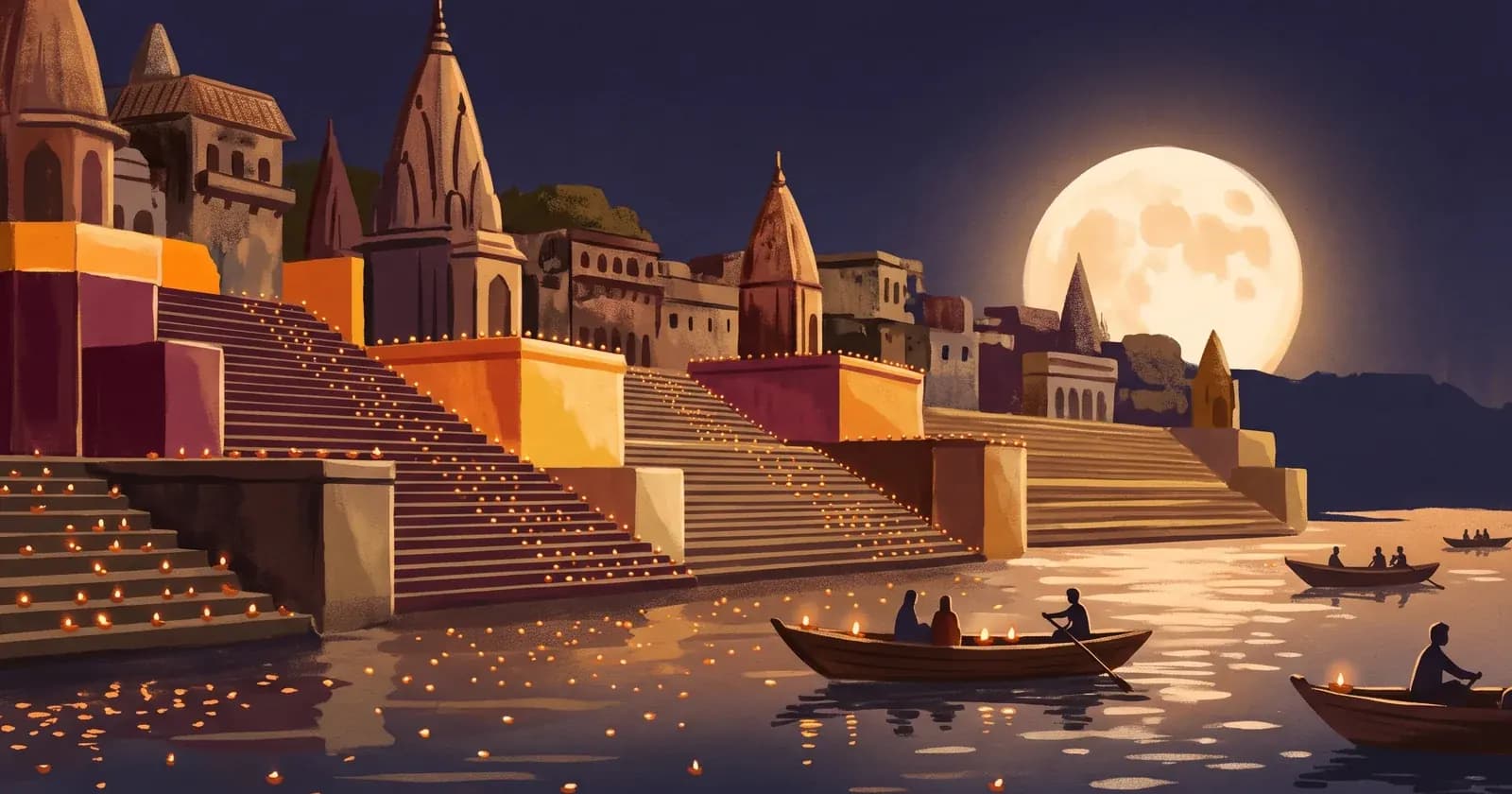
Kartik Purnima falls on Tuesday, 24 November 2026. The Purnima tithi runs from about 11:42 PM on Monday 23 November to 8:23 PM on Tuesday 24 November (IST). That evening, the ghats of Varanasi are lit with lakhs of lamps for Dev Deepawali, the Diwali of the gods.
The day before, Monday 23 November, is Vaikuntha Chaturdashi, one of the rare festivals on which Vishnu and Shiva are worshipped together.
Kartik Purnima closes the month of Kartik, which many treat as the holiest of the twelve. It is the last day of the month-long Kartik snan, the end of Bhishma Panchak, and a festival for Shaivas, Vaishnavas, Sikhs and Jains alike.
Kartik Purnima 2026 at a glance
Key dates and timings (IST)
| Date | Detail | |
|---|---|---|
| Vaikuntha Chaturdashi | Mon, 23 Nov | Night puja of Vishnu, then Shiva |
| Purnima tithi begins | Mon, 23 Nov | About 11:42 PM |
| Kartik snan | Tue, 24 Nov | Early morning, before sunrise is best |
| Dev Deepawali, Varanasi | Tue, 24 Nov | Lamps lit after sunset, around 5:07 PM |
| Purnima tithi ends | Tue, 24 Nov | About 8:23 PM |
The Purnima is present at sunrise and through the evening of 24 November, so the snan, the puja and the lamps all fall on the same day this year. In parts of North America the full moon day is Monday 23 November, because tithis are calculated for local sunrise. We explain how that works in why Hindu festival dates change every year.
Tripurari Purnima: the story behind the lamps
The day's oldest name is Tripurari Purnima, after one of Shiva's titles, Tripurari, the enemy of the three cities.
As it is commonly told, the three sons of the asura Tarakasura won a boon from Brahma. They built three flying cities, of gold, silver and iron, which together were called Tripura. The cities could be destroyed only when all three came into a single line, and only with a single arrow. Protected by the boon, the brothers and their armies harassed the gods for years.
The gods turned to Shiva. A chariot was made for him from the earth itself, with the Sun and the Moon as its wheels. Mount Meru became his bow and Vishnu his arrow. When the three cities finally aligned, Shiva released one arrow and burnt all three. It happened, the story says, on the full moon of Kartik.
The gods came down to Kashi to celebrate the victory and lit lamps along the river. That is the Dev Deepawali that Varanasi recreates every year. The names of the brothers, the materials of the cities and some other details change between versions of the story. The outline stays the same.
Dev Deepawali on the ghats of Varanasi
On the evening of Kartik Purnima, the long crescent of ghats from Ravidas Ghat in the south to Raj Ghat in the north is lined with clay lamps. Families, temples, local associations and volunteers spend the afternoon setting them out on every step, and they are lit as the light fades.
The main Ganga aarti at Dashashwamedh Ghat is held on a larger scale than on ordinary nights, with more priests, more lamps and conch shells. People float small leaf boats carrying a lamp and flowers on the river. Boats on the Ganga are booked weeks ahead, because the river is the best place to see the whole arc of lit steps at once.
If you plan to go, expect heavy crowds from mid-afternoon, road closures near the ghats, and boat prices well above normal. Arriving by early afternoon and staying near one ghat is easier than trying to walk the length of the river front.
Vaikuntha Chaturdashi: when Vishnu worships Shiva
Vaikuntha Chaturdashi, on 23 November this year, is built around a story of devotion between the two great deities.
Vishnu, it is said, came to Kashi to worship Shiva with a thousand lotuses. When he counted, one lotus was missing. Rather than leave the worship incomplete, Vishnu, whose eyes are often compared to lotuses, offered one of his own eyes. Moved, Shiva restored it and gave him the Sudarshana chakra.
On this night, temples that follow the custom worship Vishnu first, at around midnight, and then Shiva at dawn. In Varanasi the Kashi Vishwanath temple observes the day, and in some temples tulsi is offered to Shiva and bilva to Vishnu, an exchange that happens on almost no other day of the year.
Kartik snan and deep daan at home
You don't need to be in Varanasi or Pushkar to observe Kartik Purnima. The two acts that define the day, the bath and the lamp, work anywhere.
The bath. Bathe before sunrise if you can. Families who cannot reach a river add a little Ganga jal, or a few tulsi leaves, to their bathwater.
The lamp. Light ghee or sesame oil lamps at the tulsi, at the main door, in the kitchen and at any water source in the house. Many families float a lamp in a bowl of water if there is no river nearby.
The puja. Worship Vishnu or Shiva, or both, as your family does. Om Namah Shivaya and Om Namo Narayanaya are both traditional for the day.
Satyanarayan katha. Purnima is a favourite day for the Satyanarayan puja, and many homes hold it on Kartik Purnima.
Charity. Giving food, warm clothes, lamps or ghee is especially recommended this month, as winter sets in across North India.
If your family began Bhishma Panchak on Dev Uthani Ekadashi, its five days end on Kartik Purnima.
How the rest of India marks the day
The same full moon carries different meanings across the country.
Pushkar, Rajasthan. The religious heart of the Pushkar fair runs from Prabodhini Ekadashi to Kartik Purnima. The full moon is its main bathing day in the lake, which is associated with Brahma.
Odisha. Families observe Boita Bandana before dawn, floating small boats made of banana stem or paper with lamps inside. It recalls the sea voyages of Kalinga's traders to Southeast Asia.
Tamil Nadu. The full moon of Karthigai, joined with the Krittika nakshatra, brings Karthigai Deepam. At Tiruvannamalai a great flame is lit on the summit of the Arunachala hill.
Andhra Pradesh and Telangana. Many Shiva temples light lamps with 365 wicks, one for every day of the year.
Sikh households. Gurpurab, the birth anniversary of Guru Nanak Dev, is celebrated on Kartik Purnima with prabhat pheris, kirtan and langar.
Jain communities. The Shatrunjaya pilgrimage at Palitana reopens after the monsoon months, and the full moon draws large numbers of pilgrims.
What Kartik Purnima means for the month ahead
Kartik Purnima is also a turning point in the year. The next day, in the purnimanta calendar followed across North India, the month of Margashirsha begins, the month Krishna names as his own in the Bhagavad Gita. The wedding season is in full swing, and the days get noticeably shorter until the winter solstice in December.
Whatever your tradition, the instruction of the day is short: bathe early, light a lamp, and give something away.
Questions people ask
What is the date of Kartik Purnima in 2026?
Kartik Purnima is on Tuesday, 24 November 2026 in India. The Purnima tithi begins at about 11:42 PM on 23 November and ends at about 8:23 PM on 24 November (IST). In parts of North America the full moon day falls on Monday, 23 November.
Is Dev Deepawali on the same day as Kartik Purnima?
Yes, in 2026 Dev Deepawali in Varanasi is on the evening of Kartik Purnima, Tuesday 24 November. In years when Purnima does not cover the evening, the lamps are lit on the previous evening instead, so always check the year's panchang.
Why is Dev Deepawali celebrated in Varanasi?
According to tradition, the gods came down to Kashi to celebrate Shiva's victory over the three cities of Tripurasura and lit lamps along the Ganga. Varanasi recreates that celebration every year by lighting its ghats on the full moon of Kartik.
Can I do Kartik snan at home?
Yes. Bathe before sunrise and add a little Ganga jal or a few tulsi leaves to the water if you can. The intention and the early hour are what tradition stresses, not the location of the bath.
What should I donate on Kartik Purnima?
Lamps, ghee, food grains, warm clothes and blankets are the traditional gifts, and with winter setting in, blankets and clothes are especially useful. Give where it will actually help someone, which matters more than the specific item.